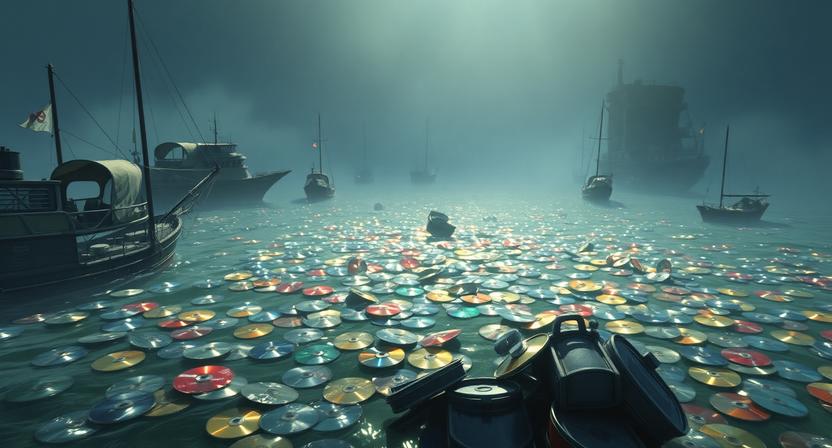
CDs Are Dead - Now What (Part 1)
What Happens When Bands Don't Sell CDs (1 of 2)
Posted by Charlie Recksieck
on 2025-12-09
In the old days - bands used to sell CDs directly to music fans.
That was great for artists like us.
Not only was it way better to sell an album for $10 and get the whole $10 instead of about $4.00 they would make when it was sold by a service like Amazon.
Not only was it a great way to augment how much a singer made at a live show and was just extra money in their pocket.
But when fans bought a CD, it meant that they listened to the music and got to know the songs.
They lived with it.
Even in recent years where there was streaming, but cars still had compact disc players, if your CD made it into the slot in somebody's car, you were in!
That driver was listening to your music.
A lot.
Here we are in late 2025.
There are no more CD players.
The Disappearance Of CDs
By 2025, CD players have quietly vanished from everyday life. New cars rarely include them, trading optical drives for Bluetooth and streaming dashboards. Laptops lost disc slots years ago to become thinner, lighter, and built for cloud storage. Even the home stereo has evolved into smart speakers that never touch a physical disc.
The once-ubiquitous CD now feels like a relic.
Music has shifted to playlists, algorithms, and on-demand access. CDs have joined records as something that still exist for collectors and die-hards, but for most people, the age of sliding in a shiny silver disc is over.
Where Bands Sold CDs
While there were CD players there were a few ways that bands sold their own music direct to consumer.
Let's define this CD-selling era as starting in the late 1990s when independent, unsigned artists had access to the means and afford technology to record their music and manufacture CDs without a record company behind them.
And that era stretches until about 10 minutes ago - or so it seems here in 2025.
At Small Shows - At casual gigs for a singer/songwriter, the sale CDs went right by the tip jar.
Which was probably about 5 feet away from the singer.
Patrons, fans and kind, inebriated strangers would love to support artists by tossing cash into the jar and taking a CD.
Even more cash if it was a guy trying to impress a girl at the bar.
It often turned a little $100 Wednesday night gig into a $160 gig.
That's not life-changing money but quite a boost.
At The Merch Table - Real merch tables are found at larger shows at larger venues where touring bands are found.
Once there is a team working the merch table, there are likely a bunch of merch options like shirts, posters besides the CD.
The psychology in buying here is at least half as much as being cool or getting cool stuff as it is about supporting an independent artist.
Even deducting for the cost of the merch, touring bands can make about 40% of their road money from the merch table.
Selling Online - Once we got digital downloads, that was just extra money for free for artists but didn't necessarily cut into CD sales that much.
And artists could sell physical media to fans directly online.
Not only would bands get the whole $10 they'd ask for an album, but there's the dirty little secret of "shipping and handling" which might have been $5 - and consisted of maybe $1.80 postage ("the shipping") and the artist or intern would earn the $3.20 of "handling".
Digital at first was a great supplement for indie artists while they could still sell CDs and downloads direct to fans.
But the payment from Spotify is crazy low - it’s nowhere near a replacement of CD income.
Bands Can Have People Listen - Or Send You Money - Rarely Both
The beauty of the old school era of five years ago was that music sales made artists money and gained them exposure at the same time.
If somebody bought music, even from a rando singer at a bar - that made them invested.
They were much more likely to put that CD on and potentially fall in love with the music or let some musical ear worms do their magic.
Even in the illegal downloading Napster era, if somebody took the trouble to download files and manually curate them in folders on their laptop, they were clearly putting enough time into the point where they were now going to actually listen to the music.
Right now, if you wanted to buy a digital download from our website - what are you going to do with that file?
Are you listening to local, downloaded files?
Are you listening to CDs?
No, you're listening on a streaming service.
Technically You Can Do Local On Streaming
Even though streaming apps prefer not to let other files into their apps for some technical reasons and more so motivations of control over licensing - there are still a couple of work-arounds, depending on the app.
Spotify - You can add local audio files on desktop and sync them to your phone - but they must stay on your device and can't be added to Spotify's streaming catalog.
You go to Your Profile -> Settings and look for something like this:

Apple Music - You can import your own files (MP3, AAC, even CDs ripped to iTunes) into your library.
Once added, they appear alongside streaming songs
But in both cases, these imported files still won't behave like normal streaming tracks.
If you imported to your laptop Spotify, you still won't hear these songs while Spotify streaming at the gym.
Plus, how many consumers are going to make this kind of effort?
If They Want To Support You, There's Still Nothing To Download
The sneaky band game-changer aspect of this is that you don't really sell CDs to people at a show anymore.
It's hard for people to listen to their local favorites while streaming.
It's hard for bands to make money and get their music heard at the same time.
Cliffhanger
Let’s stick a pin in this right here.
We discussed where we are now - next week we’ll get to what fans and artists can do in the new landscape.
This whole article is over 2000 words and unless it’s a big piece in the New Yorker it’s hard to get anybody to want to read anything over 700 words much less 2000.
Part 2 is coming
next week (available Dec 16, 2025)

